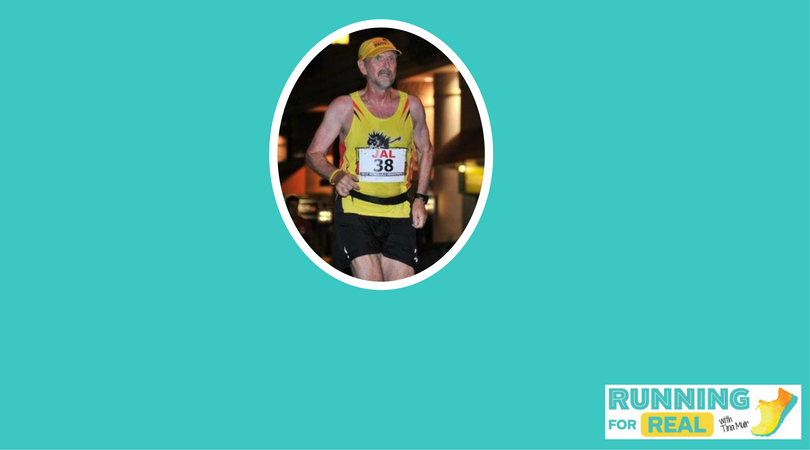
The butterfly effect is the idea that one small action can have much larger effects. If a 14-year-old named Tina Muir hadn’t met Brad Plummer, you wouldn’t be listening to this podcast today. Brad was Tina’s first coach, and without his guidance, who knows what path she might have followed… As Tina says, he is one of the most pivotal human beings in her entire life.
Listen to the Running for Real podcast here:
Apple (iTunes) Podcast | Sticher | Castbox | Overcast | Spotify | Google Play | iHeartradio |
Brad displayed outstanding running ability from an early age. He recalls that at senior school (comparable to junior high and high school in the US), “I used to go on the PE sessions, run two miles to everybody else’s one mile and still be back before them.” The records that he set there still stand, over 40 years later.
His subsequent running journey took him around the world, but it all came to a sudden halt. He was hit by a pickup truck, and had five years of his life taken away from him. He had 23 surgeries, and, he says, “My left side is made up of various screws, things that hold my face together.” Doctors told him that he would never run again. “It was a long, long journey mentally and physically to get myself back to some kind of running. But I achieved it.”
Brad went on to win gold medals as a runner with a disability, but he says, “Once I had that accident, my life changed completely. That’s how I got into coaching. I used my experiences; I learned of other people, and that’s how I crafted my own view of how to run, and when to run, and what to do, and how to help a person get through where they need to go. I learned by my mistakes to help their mistakes, and then to progress.”
Something that Brad learned and then taught is the importance of looking at the whole athlete, not just at their times. “When you teach somebody, you need to look at their everything; you need to look at the strengths, the weaknesses, and then build on that. So you look at technique, you look at how they’re running, their mental side of things and how they come through different training sessions. And then work it so they’re learning, but they’re enjoying it. Not walking off going, “I’m not coming here again; I can’t cope; I don’t want to come here again.” It’s all about you coming back, learning more, and progressing.”
He’s adamant that young athletes not be pushed too hard, too fast. “The only way anybody’s gonna learn is to learn slowly and progressively. It’s not about going out every weekend, winning a race, because where are they now? They worked so hard, and as they got to a certain age, they’re gone, because they burned out. It’s all about progression. Progression is very important when you’re building a young athlete up to where they want to go, and then it’s the building block for someone’s future.”
At a training session, he explains, “I establish what you’re feeling that night. So if you’re up to it, then I make sure you’ve done something reasonable. If you’re not up to it, then you did something a bit more light-hearted. Because the whole point of coming to training is not about, “You’ve got to do 10 times 400 at this pace,” and that’s it and be done with it. Any run you do, or any race you enter, it’s on the day how you feel. And it’s the same with training. If you’re not feeling up to run the next day, to run hard, then you run easy. It’s another day. And it’s the same with injuries; the slightest niggle, don’t go, “No, I’m gonna run another 10K hard, another 30 minutes.” No. “I’ll take a rest, give it a bit of recovery, then I’ll be able to run the next couple of days.”
From the athlete’s perspective, that approach can be frustrating. Tina remembers that as she came into contact with other top runners her age, she realized how totally different her training was from theirs, and thought, “Wow, I’m doing barely anything compared to everyone else.” At the time, she says, “I think for me there was some version of, ‘Why is he not letting me do more, why is everyone else doing more? I could be better.’ But now I look back on that, and I say this every time, I don’t know how you had the restraint to do that. I just don’t think many coaches would have been able to do that and say, ‘You know what, even if it doesn’t make me look good, I want what’s best for her.’
That, Brad says, hits the nail on the head. “It’s what’s best for you. It’s about the person you’re engaging with, and the important thing is, it’s not me. I’m only part of that. I’m part of that to get where you need to go. That’s the important thing. It’s not about my name in lights. My pride and my prowess is when you actually achieve it; that’s the end goal. Nothing else. It’s about getting you on the right road where you need to go.”
For Brad, “It’s all about helping other people. It’s never been about myself. I’m in the background, always in the background. That’s where I like to stay, you know. If anybody can take anything from our podcast, or learn by something I’ve said or done, then that would be a wonderful thing for me. That would be a proud moment for me, if anybody can take anything from what they heard today. Because hopefully it would help them in their quest to where they want to go in their lives.”
resources:
If you suffer from RED-S, or think that you may, we’ve created a free resource of over 50 videos that are available on YouTube . Experts in sports nutrition and performance answer questions submitted by real people, covering everything you may have wondered about Relative Energy Deficiency in Sport.