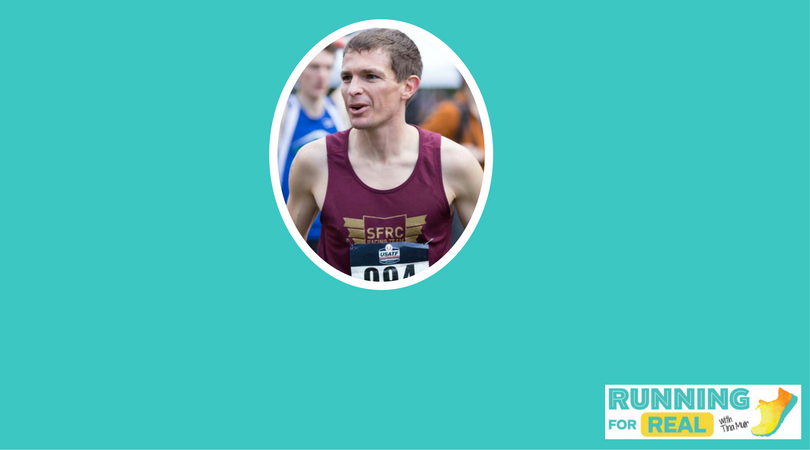
Whether it’s serving as Race Director of the Front Runners New York LGBT Pride Run, leading the Global Parkinson’s Genetic Program at the Michael J. Fox Foundation for Parkinson’s Research, or advocating for non-binary inclusion in races, J Solle supports and raises up others.
Listen to the Running for Real podcast here:
Apple (iTunes) Podcast | Sticher | Castbox | Overcast | Spotify | Google Play | iHeartradio |
It’s a mentality that they’ve had since their competetive marching band days at Drum Corps International. “It’s that kind of mentality where you all have to win,” they explain. “If one person does poorly, then everyone does poorly. And so you have to raise everyone up to the same level. I’ve kind of carried that through a lot of parts of my life.”
They even carry it through to racing. That may be because they started racing at around the same time that they moved to New York and became involved with Front Runners, a running club for people who identify as LGBTQ+ and their allies.
“I have my own challenges, my own PRs that I wanna hit. And I have an amazing support system to do that, but I think there’s something special about running as a queer running group. There’s something extra that happens when we all line up together, we’re all wearing our singlet. I think that it’s a level of being proud of doing it together. So every time we race, yes, there’s my personal result, but I’m tracking like 25, 30, 40 different people, seeing if it was their PR. It is a team sport; I really believe that.
“I have so much love for this community. It shaped my entire experience in New York. And so I will do anything I can to one: give back to that and two: make that reality something that’s possible for the next people to come.” One way that they’re doing that is by advocating for a non-binary category to be included in all races. It was introduced by New York Road Runners at around the same time that they began racing there.
“I wanted to start using they/them pronouns, but I had never felt comfortable doing it before and there was something very safe about seeing the category materialized in this way, seeing race results for people with an X next to their name. I immediately knew that this was me. I don’t feel male. I don’t feel female. Sometimes I definitely feel neither. Sometimes I might even feel both. And this complicated feeling, it just never felt right for me with my old name or with an M next to my name. And so, seeing the category out there and seeing the first couple of folks, like Zackary Harris and Jake Caswell, who actually now is my partner, being the first Front Runners to ever run in that category, it had such a profound effect on me.
“I ran my first race in the non-binary category at the 2022 RBC Brooklyn Half marathon. And when I crossed the finish line, I just sobbed; I just completely broke down because it was the experience that I had been waiting for so long that I didn’t even know was possible.”
Even with the best of intentions though, things can go wrong. “After the 2022 New York marathon, there were some things that didn’t quite go right in the non-binary category,” J says. Front Runners put together a list and presented it to NYRR. “Obviously, at the time New York Road Runners was, and still is, way ahead of the game. But the cool thing is that we came to them and we said, ‘Here’s a couple of the top things that we think for next year should be different to help really push the non-binary category up,’ and they listened and they did every single one of them.”
The key to making progress, J believes, is not allowing perfect to be the enemy of good. “There’s so much good that can be done by having a non-binary category, by making some of these changes in the implementations, like training staff to use they/them pronouns, right? It’s not gonna be perfect. Everyone acknowledges that there’s going to be missteps along the way, and I think that we can all work together to figure those out.
“At the start of having a non-binary category, you have to train people to use they/them pronouns and you might make a mistake along the way, but you just correct yourself and then you practice and you get it right next time. No one expects language to change immediately; it takes practice and you’re gonna get better at it and that’s what we’ve seen happen with New York Road Runners. I truly think that they put in a huge commitment to improve in the last couple of years in a really dramatic way and create a really good space for the non-binary community.”
Creating that good space means going beyond simply adding a new category to race registrations. “Big races have a big social media presence and talk about qualifying times,” J points out. “If we’re not including non-binary people in those experiences, then we’re leaving out a big part of the authentic experience of having non-binary people in the race. Boston now has non-binary qualifying times, but I still see infographics and posts that only have the men’s and women’s division qualifying times. There are non-binary qualifying times. Let’s talk about it. Let’s have that conversation. Or races that have non-binary divisions and have men’s and women’s qualifying times but don’t have a qualifying time that they would accept for non-binary folks. Let’s start to bring all of that up to the same level.”
As much as they welcome the opportunity to have conversations around gender in racing, they look forward to them becoming unnecessary. “There should be a time where nobody remembers races not having a non-binary category. You don’t even remember that there wasn’t that option. It should be so normalized, and just so ingrained and part of our culture that it allows everybody to experience gender in the way that is right for them.”
The New York Front Runners Pride Run, of which J is the race director, is one race that’s guaranteed to elevate the experience of all of its runners. “We are so blown away by the support to have sold out over 10,000 spots in the Pride Run in a record time. Since we sold out, we’re working on figuring out what a virtual option could look like. So stay tuned; run some Pride miles in your own city. If you’re coming to New York, come party, come celebrate with us. We throw a huge festival at the finish line. We have a huge cheer zone. It was actually the Cher zone last year. We got a life size cut out of Cher, and she cheered the whole time. So it was the Cher zone.”
Another thing that’s special about the Pride Run is that it’s a charity race. Over the past ten years, New York Front Runners has raised over $200,000 for charities that serve queer New Yorkers. This year’s recipient is the Audre Lorde Project, a community organizing center for LGBTQIA + New Yorkers of color.
For J, helping others goes far beyond advocacy within the running space. They currently lead the Global Parkinson’s Genetic Program at the Michael J. Fox Foundation for Parkinson’s Research. “I’ve always worked in nonprofit health work and it’s just something that I’m incredibly passionate about. So the opportunity to dive into a real challenge, like Parkinson’s disease, it energizes me.”
They believe that resilience is key to succeeding in challenging situations. “If you see and are connected to the end cause or the end mission, whether that’s better therapies for Parkinson’s disease or a non-binary category in every race, I think that if you keep that whole picture, one fall or one hill or bump along the line is just that. You have to get up, and keep moving towards the end goal.”
It’s a belief that they put into practice at the 2022 Cherry Blossom 10 Miler in DC when they and some friends were assaulted. “It was very clear that they did it because we were queer,” J says. “We texted our group of Front Runners who were down there and everyone was dismayed, obviously, but the only thing that we could think of doing was going out and running proudly the next day as our authentic selves, wearing our Front Runners’ gear with our Pride flags, and running the race because that’s what we do. We go out and we run our colors proudly. We’re resilient, like I talked about before. It’s a little bump on that hill and it’s scary. But we conquered it together, is the point that I’m trying to make,and that’s that community moment where I’m like, ‘This is so special. This is so unique.’”
Photo credit (podcast player inset): Da Ping Luo/NYRR